The Resume Has Stopped Being Human
I've read hundreds of these now, and increasingly I can't distinguish one senior leader from another by their resume alone. Not because the leaders themselves aren't different, but because the resume has stopped showing me that.
Aug 25, 2026
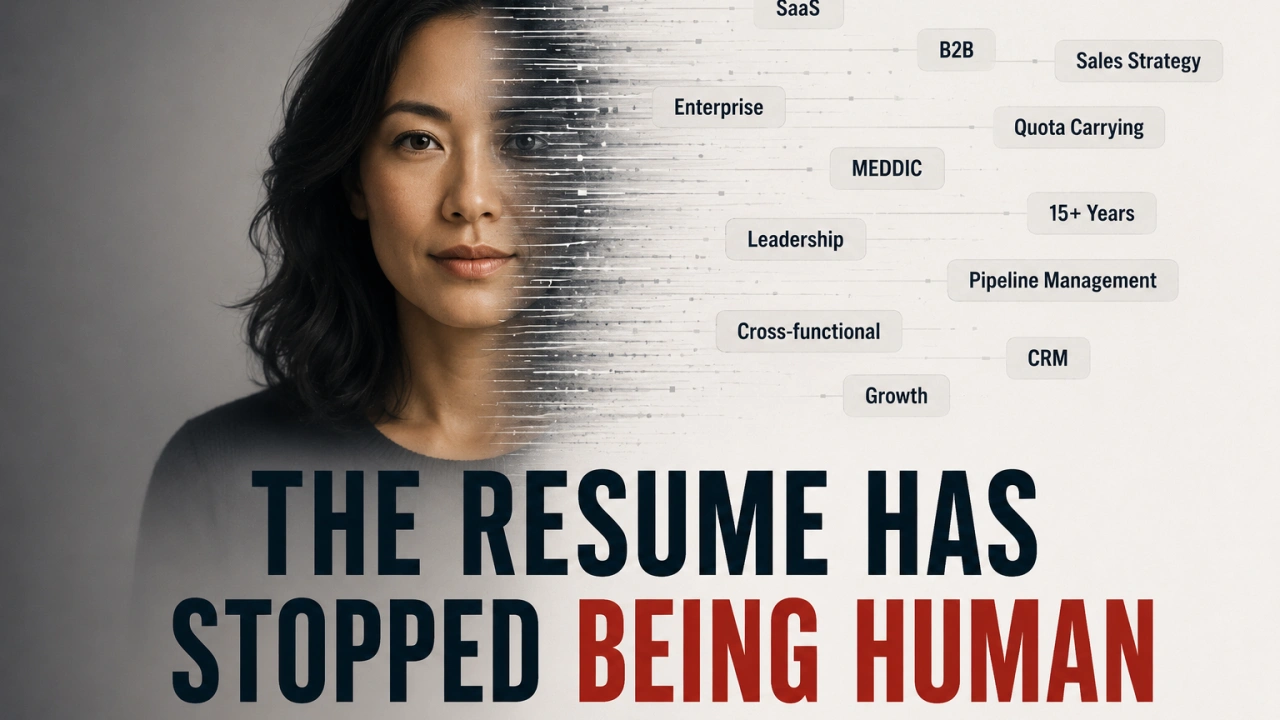
I sat with that particular resume for a long time. Fifteen years of work, reduced to a wall of bullet points that could have belonged to almost any sales leader. "Drove 34% YoY growth." "Managed stakeholder relationships across APAC." "Aligned key stakeholders across cross functional business partners".
I've read hundreds of these now, and increasingly I can't distinguish one senior leader from another by their resume alone. Not because the leaders themselves aren't different - they're wildly different the moment they start talking - but because the resume has stopped trying to show me that.
What I'm seeing
CVs are simply turning into keyword inventories. Tag enough of the right terms, survive the AI screen, then get a human to glance at you for six seconds. That's the trick. And the resumers themselves are getting denser by the year with even more achievements crammed into less space, while somehow saying less. The actual human story, how someone thinks, what they care about, what makes their approach theirs, has been edited out entirely.
In my mind it's the wine list problem. Open any wine list at a mid range restaurant and you get grape, region, price. Nothing about why this Shiraz tastes like a different decision than that one. Nothing about the winemaker, the year that nearly went wrong, the choice that made it distinctive. So you do what everyone does - you scan for a price point you're comfortable with and pick whatever's in the middle. Not because it's right for you, but because the document gave you nothing else to go on.
Good restaurants solved this years ago. They didn't fix the list, they put a sommelier in front of it. A human who could look at what you actually wanted and make the case for one bottle over another.
Instead when it comes to resumes, we seem to have flattened the list and then forgot to keep the sommelier!
How we got here
We have seen two forces, pulling in the same direction. AI tools optimising resumes have taught a generation of candidates to write for the parser, not the person. This means match the language of the job ad, mirror it back, get through the gate. And the genuine, well-intentioned push to strip bias out of hiring has, as a side effect, it has stripped out a lot of what made someone recognisably themselves on the page. Both started as reasonable responses to real problems. Together they've produced a document that's technically optimised and humanly absent.
Here's the part I think we're avoiding - that second effort hasn't made hiring fairer. It's made it more homogenous. Removing the story didn't level the playing field. Instead it just made everyone equally invisible, which is a different thing entirely and a much easier thing to mistake for progress. Stripping bias signals from a document doesn't strip bias from the human reading it. It just removes the person's ability to give that human a reason to look past it.
What I think we're missing
I don't think the answer is fighting the resume on its own turf. Its job is narrow ie: to get a person through a filter and into a room. Asking the resume to also carry someone's full story is asking one document to do two incompatible jobs at once. The fix isn't to overload the resume. It's to stop pretending it's the only artefact that matters, and to put the sommelier back.
The human story has to live somewhere. A LinkedIn profile that actually sounds like the person who wrote it, not a recruiter's template. A short video introduction prepared by the candidate before the interview. A one page narrative leave behind that sits alongside the formal CV, not instead of it, that makes the case for why this person's approach is different, told in their own words. Even just a hiring manager willing to ask "tell me about a moment that changed how you lead" instead of walking through the bullet points back at the candidate.
This is, genuinely, a lot of what I do in a coaching room. Not polishing the resume. Finding the leader's story and helping someone carry it into the conversations that decide whether they get hired, promoted, or trusted with the next hard thing. The resume gets you to the table. It was never going to be the thing that got you the seat.
We didn't dehumanise hiring by accident. We did it deliberately, in the name of fairness, and called the flattening "progress". It's worth asking whether removing the human story actually made hiring more equitable, or just made it easier to scan?